Tag: Kelowna foreclosures

  • Rom’s July Real Estate Stats & Opinion

    Rom’s July Real Estate Stats & Opinion

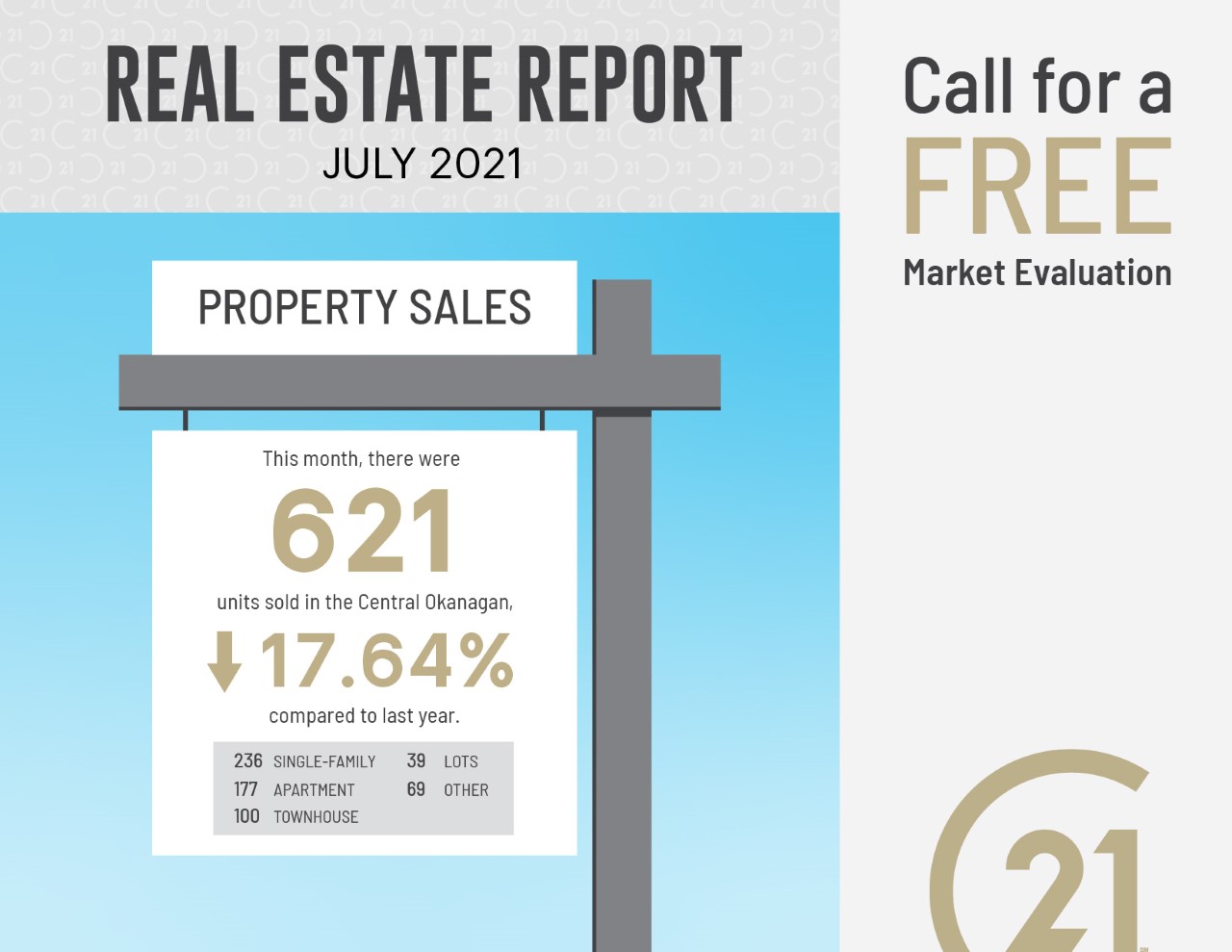
    Okanagan Real Estate Report July 2021

    Rom’s Real Estate Opinion

    The market is progressing exactly in the direction that we anticipated. Things are settling down but definitely not crashing.

    Think of the market in the last year as something like a Chicken Little scenario from the 1943 Disney Movie. For the last 6 months the market has been running around with his hands waving in the air screaming and yelling that the sky is falling. In other words, the absorption was ridiculously high, the inventory was ridiculously low, monthly sales we’re breaking all historical records and price increases we’re breaking all historical records.

    What’s happening now is Chicken Little is settling down. The absorption in the Central Okanagan (Peachland to Lake Country) has now dropped to between 40 and 50%. The inventory is still very low and sales have dropped to a reasonable level. However, let’s keep this in perspective. Absorption between 40 and 50% is still off the charts for our area. A balanced Market is considered to be 12 to 18% depending on which expert you listen to. Below 12% indicates that you can expect price decreases and it is also considered a strong buyer’s market. Above 18% is considered a seller’s market and you can expect price increases with this level of absorption. 40% is a long way above 18%…

    Where is the market going to go from here and why?

    What has to change in order for prices and sales to drop dramatically? If we look at the inventory for July 2021 and compare this with inventory levels in July 2020 and 2019 then this July inventory level is less than half the other 2 year averages.  Although over time inventory levels will typically gradually increase as more houses will be built, more construction and development. However, in order for the market to change dramatically to even approach a balanced Market the inventory has to increase dramatically; likely more than double. Is this going to happen? This is the big question.  We will not get rid of multiple offers on the same property until that inventory increases. That is just basic logic. 

    Conclusion

    I think we will see this present direction of the inventory, absorption and sales start to level off at these relatively higher levels. The market has settled down from its Chicken Little level to its “normal” place in the regular cycle. 

    If you would like to find out what your home is really worth in a market like this give me a call or text me at 250-317-6405 and I would be happy to evaluate your home. It can be done completely remotely if you prefer. It is totally free.  As always have to remember that’s just the Real Estate World according to Rom.

  • What you should know about BC foreclosure procedures

    BC FORECLOSURE PROCEDURES

    Many buyers are not familiar with the BC foreclosure procedures and therefore feel uncomfortable to put in an offer on a foreclosure listing.  I hope the following will provide a better insight in the judicial procedure and why it is important to deal with an experienced realtor who understands foreclosures.
    1. The whole process starts with a Demand Letter from the lender accelerating the loan and giving the borrower a short period of time to pay out the mortgage or else facing foreclosure.
    2. After, a Petition is filed in the BC Supreme Court Registry where the petitioner is the lender and the borrower and other lower in priority ranked lenders are the respondents.
    3. Order Nisi ordered; this is the first order of the Court that fixes the time for redemption.  Redemption period is usually 6 months, this is the time period given to the borrower to redeem the mortgage with accrued interest charges.
    4. Second order, the Conduct of Sale by the Master (called Judge in foreclosure procedures) will be ordered.  Usually after redemption period expires. The lender act now in the role of the Vendor and can list the property for sale with a realtor.
    The assigned listing realtor has to provide to the lender’s lawyer: a Comparable Market Analysis report (CMA), suggested list price and what the property likely will sell for.  The lender’s lawyer will provide amended listing documents, guidelines for listing and the Schedule A.
    The Schedule A is very important and will be part of the contract of purchase and sale and therefore the offer.  It amends or null and void certain clauses in the Contract of Purchase and Sale form. For example, it always states that buyer will obtain the property “as is where is”.  Make sure you deal with a realtor who understands and review with you this Schedule A.  Once an offer has been accepted the listing realtor needs to prepare a marketing report that will be used as affidavit in Court.   Once the realtor receives an offer, the listing realtor has to provide guidelines of the offer if available and the Schedule A to the Selling realtor, also called the buyers agent.  Important is that the buyers agent provide the full legal name on the contract.
    Once the offer is accepted and all subjects are removed there will always be one subject left in contract:    “Subject to Court Approval”
    This subject removal will trigger a court date, typically within 10-21 days after removal of all conditions.   The Buyers agent should always contact the listing agent a day before the court date to see if there is a possibility of competing offers in Court and should write a back up offer.
    The accepted purchase price is public, so any potential buyer can either call the realtor and if the realtor doesn’t want to disclose, the buyer can go to court and find out what the purchase price is.
    Any party can present an offer to the court and they will give the offer in a sealed envelope to the listing agent.  Please note, all these competing offers should be subject free other than “subject to Court Approval”.
    Procedure In Kelowna Court:
    Vendors Lawyer presents the offer to the Master and the Master asks if any party would like to submit an offer.
    1. The Master will approve the sale based on considerations such as: appropriate marketing efforts have been taken place by the realtor  (aforementioned affidavit from the listing agent), there is a substantial deposit either by draft or certified check, and the purchase is above or at appraised value.  If not, it is still at the discretion of the Master to approve the sale.
    2. In the event that there are competing offers in Court, the Master asks the Vendors Lawyer if he or she has received all offers in sealed envelope and besides the considerations mentioned above, the Master will accept the highest offer. Sometimes the difference could be as little as $500.00.  It is important to work with an experienced realtor to work out an offer strategy.
    In some cases the Master order to have all parties leave the Courtroom and resubmit all final offers.  At the end, it is at the Master’s discretion what offer he or she will approve.

    Important: always deal with a realtor who has experience with foreclosures. Rom would be happy to help you when you are thinking of buying a foreclosure property.

    Phone: 250.317.6405 or Email: Rom@RomRealty.com

  • Buying Foreclosure Properties in Kelowna, British Columbia

    Irrespective of economic conditions, foreclosure properties are often viewed as a “deal” for the savvy real estate investor. However, courts in British Columbia have a duty to ensure that foreclosure properties are being sold as close to their fair market value as possible. Usually this means ensuring that a property is marketed with a REALTOR on the MLS system.  Here are some key points for Home Buyers to remember when they are buying foreclosure properties in Kelowna and other parts of British Columbia:

    1.      Offer is Subject to Court Approval.

    Buying a foreclosure starts much like any other real estate deal, except that often you are negotiating with the Bank, the Bank’s Realtors, and the Bank’s Lawyers. This means that offers must be open for acceptance for longer periods of time to allow the institution’s foreclosure committee time to consider your offer.  Unlike a regular real estate deal, just because your offer has been accepted does not mean that “You Have a Deal”.

    All deals are subject to court approval. This means that a judge (or master) must approve the terms and conditions which have been agreed to by the bank. The judge will be ensuring that the current home owner has been given proper notice of the proceeding and that they have not “paid out” or redeemed their mortgage prior to the Court Date.

    A Buyer should keep in mind that a judge has absolute discretion in her courtroom and success in court can never be guaranteed. The outcome will vary depending on whether the application by the lender for sale of the property is uncontested, contested by the home owner, or if there is multiple offers presented in court.

    2.      No Other Subject Conditions

    The offer which is presented to the Court (and the Lender) must not contain any subject conditions for the benefit of the Buyer. In most real estate transactions, subject conditions allow time for a Buyer to perform due diligence on the property they are purchasing while binding the Seller to the deal (for example: obtain a home inspection). In a traditional real estate deal, if an issue is discovered (ie; a leaking roof) after the deal signed but prior to subject removal, the Buyer will have an opportunity to re-negotiate with the Seller and will not be legally obligated to complete in the face of the new information.

    In foreclosure transactions, the Buyer must do all due diligence prior to knowing if their offer will be acceptable to the bank or the court. This means that a Buyer is faced with a dilemma: a) potentially spend thousands of dollars on home inspection costs, appraisal fees, and other consultants only to have the property purchased by another party on court day; or b) buy an “as-is” property without proper due diligence which may have many costly unforeseen complications.

    Financing is one area in foreclosure transactions that cannot be overlooked. Once the court approves the offer, the Buyer is legally obligated to complete the transaction and pay the Purchase Price. Buyers must ensure that their mortgage brokers have received an unconditional approval from their lender prior to proceeding to Court.

    3.      Property Purchased “As-Is”

    In a standard residential real estate transaction, the Seller provides a Property Disclosure Statement which provides the Buyer with a modest amount of disclosure on the condition of the premises.

    One of the key differences between a foreclosure purchase and most residential real estate transactions is that the Buyer is purchasing the property “As-Is”. In a foreclosure, the seller (Lender) explicitly is making no representations or warranties about the Property and there is no Property Disclosure Statement which is provided (or it is simply blank).

    When a Buyer is purchasing a property in “As-Is” condition, the onus is on the Buyer (caveat emptor) to ensure that the property meets the Buyer’s needs. Commonly foreclosure properties have issues including: non-compliance with bylaws, illegal activity, squatters, no occupancy certificates, unhealthy conditions (mold), and very poor maintenance.

    The Buyer needs to understand that the condition of the premises may change dramatically between the date of viewing to the date of possession. The Buyer is inheriting all these potential issues, “warts and all”.

    4.      Be prepared for Court

    Once a Buyer’s initial offer is accepted, the Lender’s lawyers will set down a date in Court for approval of the offer. This initial offer becomes part of the public court filing and other parties may show up in court to present better offers. The Lender’s sole responsibility is to set the date for the chambers hearing, if the initial Buyer wishes to have the option of revising their offer in Court (usually in the face of competing offers) they (together with their agent) should attend in chambers on the date. Buyers are well advised to have their “BEST OFFER” ready on the court date (with an appropriate deposit in the form of a Bank Draft) if there are competing offers.

    It is important that any offer presented to the court should contain the correct information as the court will rely on the offer to draft the Order Approving Sale which will be filed in the Land Title Office by the lawyers for the successful Buyer. Care should be taken to ensure: Correct Legal Names of Purchasers; Correct Legal Description of All Property; and Correct Description of Property Interest Acquired (i.e.; Leasehold v. Freehold)

    5.      Closing and Possession Issues

    Once you are successful in Court and the Court has granted you, as Buyer, an Order Approving Sale, there are still a number of potential complications. At this stage it is important that you are using the services of a Real Estate Lawyer familiar with closing of distressed and foreclosure properties. Obtaining title to your new home is much different in the case of foreclosure property as there is no transfer filed in the Land Title Office and instead the actual Order Approving Sale is reviewed and approved by a Land Title Examiner. If there have been any mistakes in drafting of the order by the Lender’s counsel, the order may be defected by the Land Title Office and the Lender’s counsel only obligation will be to correct the order.

    Possession of a foreclosed property is not guaranteed on the Closing Date. A tenant, squatters, or the former owner may be present on the property. In this case the bank is only required to use reasonable efforts to obtain another court order (writ of possession) ordering the property be vacated. This process can take additional time. A Buyer should not rely on timely possession of foreclosure property.

    6.      Liability Issues

    In summary, Buyers assume a number of additional liabilities when foreclosure property is purchased, including:

    a)                Property Damage

    b)                Property Non-compliance with law and by-laws

    c)                Illegal Activity

    d)                Adverse Possession of Premises

    e)                Potential Tax Liability (GST and Non-Resident Withholdings)

    f)                 Potential Strata Assessment Liabilities

    Foreclosure property purchases can represent a good deal for many savy and experienced property investors however, Buyers should carefully enter into these arrangements fully educated on the risks of purchasing foreclosure property.


    Compliments of Peter Borszcz, Real Estate Lawyer, Pihl Law Corporation
  • Kelowna Foreclosures Nov 17 – Dec 10, 2012

    Click below for the most recent Kelowna foreclosure listings:

    Kelowna Foreclosures

  • Kelowna Foreclosures Nov. 4 -16, 2012

    Please CLICK HERE for an update on all Kelowna Foreclosures.